Showing posts with label otters. Show all posts

Thursday, April 2, 2015

A Still Point Below the Blow and Bother of Winter: March 12 & 22, 2015

We had to wait for a cold sunny morning after a brief thaw so that the snow would be icy enough to walk on. We were still on snowshoes. The snow in the woods is up to three feet deep. On a cold sunny morning after a brief thaw beaver ponds can begin to look rather basic. On the morning of March 12 the Lost Swamp Pond seemed to be losing it pretenses.


Hard snow merged into that wasted brown ice caused when the whole facade of a pond collapses into what pond water is left after the otters breached the dam. The beaver lodge gave no impression that the beaver or beavers inside ever climbed out from under the ice to have a look around. Not that I expected that since lone beavers or a kitless pair are never very venturesome. I hoped for signs of life at the dam because otters usually scat and renew their claim to their winter domain.


I could see a small array of scat, about where they had been scatting before. My theory is that two otters, mother and pup, have been living here since the first of the year. If that were the case, shouldn't there be a bigger pile of scats? And since the snow was softer during the thaw, why weren't there some fresh prints or slides? The scats did look like they might have been deposited in the last 24 hours. Had they been there longer they would have sunk deeper into the snow.


I tinkered with the photo editing and think I did bring out some urine stains and a hint of a trail in the hard snow.


Then I looked for a hole an otter could use to get out from under the ice. Walking behind the dam is always hazardous especially when you are trying to prove that animals have been swimming in the water under the ice which invariably makes the ice above weaker than it appears to be. So I didn't venture too close to three possible holes behind the middle of the dam. Staring at the photo below, I can fancy that I see several otter trails in snow up the dam but the two on the right could have been made by deer. And why wouldn't the otters slide on the hard snow? There were two pocky depressions in the snow behind the dam maybe caused by sinking otter scats.


But the most convincing evidence that the otters were still there was the water still rushing out through the dam. There was quite a flood in the small usually empty pond just down stream. The brief thaw we just had wouldn't have caused that. The otters must still be digging their hole in the dam deeper, but there will be no proof for that until the final thaw.


When we came back to check the pond on the 22nd, we saw that brief thaws had compacted the snow and the cold of the night before made it so icy hard we didn't have to wear snowshoes. At the Lost Swamp pond we could see more brown ice and the beaver lodge had lost its snow cover.


I didn't see any otter scats on the lodge. There was no evidence that any animal had been on the lodge, no coyotes, no beavers. There was some clear ice in front of the lodge and bubbles frozen under the ice.


Evidently the beavers broke the ice there, had a pool of water to swim in for the first time since December. The water froze again and as the beavers swam under the ice, air escaping from their fur left bubbles under the ice. Of course, the otters could have left the bubbles, or muskrats. I headed to the dam hoping to see otter signs or evidence that a beaver climbed out from under the ice. I went directly toward gaps in the ice behind the middle of the dam, but it was very difficult to see any otter or beaver tracks in the hard snow behind the dam.


But to the right of that hole, in the brown ice behind the dam, I saw otter slides but not at all fresh.


Tracks made in ice or wet snow on ponds can be preserved in the next freeze, covered by snow and then be revealed after a thaw weeks later. I can't be sure when an otter made these tracks, but they don't go far from the dam like the fresh tracks I saw there a month ago. Years ago when beavers maintained several ponds nearby, the otters I watched generally went from pond to pond in February and in March the mother otter tried to separate from her pups to mate and have this year's litter of pups. (The upshot of last Spring's mating, thanks to delayed implanting of the embryos.) But in 2010 when there was only one other pond nearby for otters to go to, as far as I could tell the mother and her two pups stayed together until the snow melted in April and I saw them together in the pond in May. So if these otters spend the whole winter and much of the spring here, I will not be surprised. There are no ponds within almost a mile that could sustain them. But the hard snow and old ice I faced today was hard to decipher. I only saw a few scats sunk in the snow just west of the dam in their usual latrine.


But this was a rather feeble array, possibly not otter at all, and I saw no otter tracks. But I did see an indistinct hole in the snow.


An otter certainly didn't climb out of it. If one had, the edges would be rounded. But I saw a round tunnel going from the hole toward the latrine.


Minks are the consummate tunnel-makers in the snow but minks seem lax about keeping up a latrine next to a dam the way otters do. The tunnel in the snow was wide enough for otters. Over the years, I've stuck my camera down holes in the ice, soaking one camera in the process, and now have a collection of photos showing the otters' world under the ice. Those photos also show the beavers', muskrats' and minks' world too. 

I can't generally see what the camera sees, and in the bright sun can't see the images it captures. So I take several shots and hope for the best. When I got back home, I realized I had taken my best photo ever of the under ice world. It showed the canopy of ice above merging into the thick pond ice and a flat rock in the airy gallery formed as the water level dropped after the otters breached the dam. The rock was comfortably above the current water level. That water was frozen with the flaky look of thin ice.


The green stick was probably the remains of a beaver's meal. I zoomed in with photo editing and think I see fish bones left by an otter or mink.


If I am lucky I'll see all this when the snow melts, but probably not. The water in the pond will rise with the thaw and all this evidence will be washed away.

Back last summer I took a photo of some rocks near the one I accidentally photographed in March. Those summer rocks are about a foot higher.


This pond lost a lot of water thanks to the otters' hole in the dam. Too many naturalists think beavers will not accept such a catastrophe. In my experience, they always accept it, take advantage of it, and often breach the dam themselves. I admit usually the ice covered galleries I've photographed over the years look like dank refuges, but not this year. I found a winter paradise, a comfortable niche in the long airy tunnel formed under the ice that runs behind the dam and along the shores of the pond, all thanks to the otters' hole in the dam.

Good thing I didn't clearly see my under-the-ice photo until I got home. If I had known what I stood over, it would have been hard not to try to crawl under and enjoy that still point below the blow and bother of winter.

Thursday, February 26, 2015

February 18, 2015

Four weeks since I last checked on the otters, that's how cold it has been. The snow has piled up in the woods. Porcupines reached that blissful state where they could walk to the trees they love almost completely enclosed in the troughs they had worn down in the snow.


Unfortunately the trough I made with my snowshoes went down another 2 feet in the snow. Half way to the Lost Swamp Pond I almost gave up and backtracked home. But slow as snowshoeing is in soft deep snow, I tried to think like the wind and avoid drifts. That hardly worked, so I walked 30 yards and took a break, again, and again. I crossed two porcupine trails but they always go from ridge to ridge, tree to tree, never to the swamps. I did merge with a deer trail conveniently heading in the direction I wanted to go. Usually they don't. Deer have a knack for heading to the low hanging thorns.

The deer saved me 50 yards of hard trudging, leaving me another 100 yards across the frozen pond. I could see tracks on and below the snow covered beaver dam.


Either the deer walked around the pond and found slush if not puddles of melt water to drink behind the dam or the otters had been out. Walking toward the dam, I passed the beaver lodge which didn't show any signs of recent life.


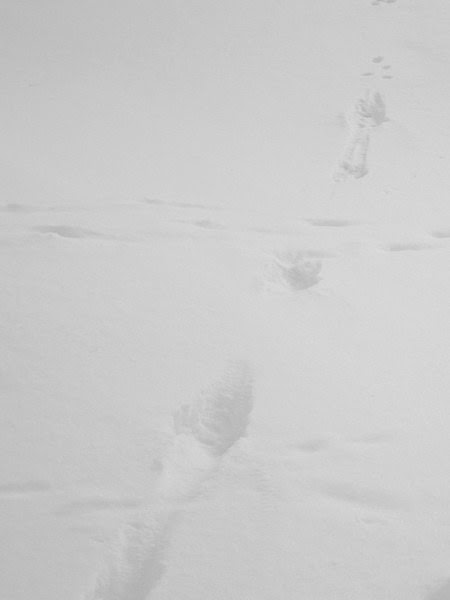
But it was not all smoothed over. Something had been on top of it a week or so ago, probably the otters. I soon saw that it was certain that the otters had been out behind the dam probably within the last 24 hours. They didn't slide on the snow. They leaped through it.


Their foray to the south did not go far. It looked like they almost nosed down to the pond ice and leaped back the way they came.


There is a hole where the pond ice meets the dam. Usually I crawl right up to such holes, stick my camera down it, assuming the water level is well below the ice as usual, and see what my camera can see. The snow was too deep for that. So I tried to figure out what the otters had been up to through the past few snowfalls.


Not an easy read. In February otters usually begin ranging around the pond, if not head to another pond. These otters appeared to have that inclination but kept being defeated by the depth and softness of the snow. But I'm probably reading too much into what little I saw. Judging from the close-up I took of the hole, no otter had been out that morning, though the hole looked well used.


Looking to the left, I saw more holes and the troughs from forays probably several days old.


The tracks at the west end of the dam looked almost fresh and gave the impression of otter pups following their mother up the slight slope to poop in their usual latrine.


As I took the photo above, I saw a hole in the ice low behind the dam but that didn't appear to be the hole the otters came out of, maybe one otter came out there a few days ago.


I trudged up the slope and saw that I was right. There were a couple of scats and, adding to the mystery, a tunnel that the otters made under the snow. Down along the dam I saw what might be a hole going down in the snow maybe to a hole in the ice.


But I didn't walk over to check. I am pretty sure no other human would come out to see this. Other than scatting to renew their claim on this pond and ward off any other otters from trying to come under its ice, the otters placed no meaning in their scampering about. But for the moment it was sacred to me. So I contented myself with taking a close-up of the snow tunnel and the scats.


Only half wishing I was Alice, I headed home and careful to retrace my steps made it non-stop.

Thursday, January 29, 2015

January 24, 2015

We headed off to check the Lost Swamp Pond on the 17th, a rare warmish day, just below freezing for the past 36 hours. Those conditions might get otters out of their holes. Despite their reputation for being playful, during a cold January like we are having this year, otters only come out from under the ice every few days or so to sniff around for a few minutes and poop. The amount of poop suggests how active they are under the ice. Meanwhile the pond changes, drastically. We noticed the hole in the dam on January 2. When we checked on January 11, the pond was just beginning to respond to its loss of water. On the 17th there was what looked like an open wound in the ice next to the beaver lodge.


Despite the day's warmth, there was ice under the original layer of ice. That original ice looked to be about 4 or 5 inches thick and it looked like there was a drop of well over a foot to the new level of the pond ice.


There were no signs of anything like a beaver or otter coming out of that opening. On the way to the dam, I picked up a mink's trail


Minks can manage to get under the ice without otters around, but minks can't resist taking advantage of the holes the otters make. I followed the mink to a hole just behind the middle of the dam


While the mink used the hole, it didn't level about a shovel full of snow just outside the hole. An otter did that and left a couple prints. But I had hoped for more and at least a scat left in the snow. Standing on the dam, I looked down and saw that there was still a good flow of water coming out of the hole or holes the otters made.


Looking behind the dam I could see that the pond ice lowered uniformly except where the ice was braced by the dam, an old beaver lodge and tree stumps. All the old tracks behind the dam were probably left by deer.


Usually collapsing ice leaves a more roly-poly surface so I was a bit disappointed. A week ago I saw the tracks and scats otters made when they came out of a hole high on the bank about 30 yards west of the dam. I headed down there and saw that the pond in that direction was a bit roly-poly but more like a gentle wave, not the slash of ice planes I expected.


On the 11th the hole in the bank that the otters used was a couple feet above any water under the ice. Now it had to be even farther removed from the otters' source of food and the otters obviously stopped using that hole.


I was sure that the otters would suffer no inconvenience if I stuck a camera in the hole. I've taken these blind shots for years and the images I got this time were not very good. It looks like muskrats took advantage of rotting tree roots to make a den. I had often seen muskrats swim out of the bank around here, never any beavers. My guess is that the otters found the muskrats' old den and then dug a hole out to the open air. More snow and ice will have to melt before I can prove that.


In January all the stories the swamps tell unfold slowly. On January 24 I hiked out alone, again taking advantage of warmer temperatures and mindful of a chance of snow. We have not had much snow this month. Usually after a general snowfall of 6 inches we keep getting in an inch or two of lake effect snow every few days so that snow mounts. But this year we are losing snow very slowly from melting and sublimation. That's bad for otter tracking but it's good for seeing how the pond ice responds to a hole in the dam. When I got to the Lost Swamp Pond late in the afternoon I could better see the conflicted ice.


The otters apparently didn't squeeze out what holes cracked open when the ice sheet of the pond collapsed around those dead tree trunks. But the ice held up by shrub trunks next to an old beaver lodge, which would be an excellent place for the otters' to den, told a different story.


Getting closer, I got one of my best photos of ice showing bubbles likely left by otters swimming under ice now locked in a block of clear ice hanging high and dry over the current level of the pond ice that showed air bubbles made by the otters swimming under that ice.


The tracks in the snow around and on top of this ice platform were harder to decipher and I didn't see any otters scats in the area. Behind the other end of the dam there was another ice platform where some animals messed around.


Otters did much of the messing in that snow because I could see an otter slide in the ice between a gap in the ice right behind the dam and the ice platform.


In the upper left hand corner of the photo above there is what I hoped was a pile of otter scats, but it turned out to be coyote poop. The otters latrined on top of the dam,


leaving a muddy choppy trail in the snow all the way up to a generous pile of scats.


I didn't examine the scats too closely but it looked like the otters had been eating small fish, shiners, pumkinseeds, not the bullheads that used to make many an otter's meal in this pond. Between the scats and the pond ice, I saw a thin stick that a beaver had nibbled. Perhaps a beaver used the holes in the ice behind the dam too and came out in the cold fresh air for a snack.


All the activity I saw looked recent but since what could have been open water was all iced over, and since the bubbles under the ice were white and not pulsing with fresh air, and since there seemed to be no water flowing out of the holes through the dam, I couldn't positively say the otters were still there. When there were several active beaver families on this end of the island, otters moved from pond to pond, often traveling in late January. But this pond is about the only sure spot for a meal of fish within a mile so the otters might stay here all winter. It looked like they were having a good time so far. I'll check the pond again after we have some snow that will whiten the slate clean, so to speak. Heading home through the woods, I saw spots of blood in the snow.


I followed a trail of blood but no prints to the underside of hanging log. Such light footed work in the dawn hard snow, a weasel probably made the kill.

Friday, January 16, 2015

January 11, 2015

The foot of snow in the woods was deep enough for a porcupine to make a respectable trough.


That graceful trail came down from the rock dens half way up the steep slope on the east side of a wide ravine. At the other end of the woods there was another porcupine trail coming out of a den in low rocks completely covered by the snow.


Standing on the rock ledge looking down at the den has been my first sure stop in the winter woods for many years. Sometimes a porcupine was looking back at me. Not today. Then I faced the Big Pond. When it was indeed a pond, it was generally easy to cross in the winter because the west wind blew most of the snow off it. But now I faced a meadow.


The snow is always deeper in meadows and tracks are not easily seen. I miss the old days when I often saw tracks in the inch of snow spared by the winds that revealed the capering of coyotes. The Lost Swamp Pond was easier to cross. When I left the pond on the 2nd, I had the impression that the otters had breached the dam. So I expected the ice on the pond to have collapsed here and there as its water drained out. However, the snow was deep enough to smooth over any appearance of collapsing save where I saw a pool of slush beside the lodge which marked the new level of the water below the ice, perhaps a foot lower than it had been.


As I walked on I crossed the trail left by two deer as they investigated that low point, probably to get a drink of the water puddling there. Of course, I kept looking at the dam where I expected to see otter slides. I soon saw that there were none to be seen.


There was a depression in the snow behind the dam that went down to the new water level but it certainly didn't look like anything had used it to get under or out from under the ice. Because the beaver here doesn't forage for trees to cut, it hasn't had much interest in building up the dam and keeping the water level high. So the hole in the dam has been draining water out of a pond that did not have a high water level to begin with. For that reason, I expected the otters to live in the dam where muskrats over the years have fashioned dens. Several years ago otters breached the dam in December, went somewhere else and didn't return until late January, or so I recall without checking my journals. But otters keep sashaying around ponds and the river in December. When the cold hits in January, and we've had nights near 0F, otters get serious about settling down. I saw that water was still flowing out at the bottom of the dam.


Often the otters that made the hole keep tabs on it, but no signs of that. When this pond did have plenty of water and the otters breached the dam, they often found a den at the far west end of the pond; I suppose because the ice was thinner and easier to break through. So I walked down there. I saw deer tracks where I used to see otters coming out of holes in the ice. Not sure what the deer was after.


Then I saw a well used hole along the north shore of the pond up in the bank. I'd never seen otters here use a hole like that before but it immediately made sense to me.


Ideally otters like a den that offers them both access to the under ice world where they get their food and a place under the sun where they can poop and get a breath of fresh air for a few minutes. Since muskrats had often burrowed into the bank, I knew the otters could find a nice den there but with the pond so low, there was no easy access under the ice from there. However muskrats specialize in surviving in shallow water and they can mole their way under the ice leaving a nice little trench going from the bank out to a deeper part of the pond. Maybe the otters were taking advantage of that. No way I could tell until the next thaw, but I could document the otters' very brief dance outside their hole. There was a trough going a few feet along the bank to the west


And that's where an otter scatted.


Then there were two forays down the slight slope and out on the snow covered ice. The foray angling right ended at a small dead stump sticking out of the snow.


My hope is that a family of otters is using the den, which means a mother and pups born back in April 2014. It was easy to see the prints of an adult otter.


Only in the foray angling slightly left from the hole could I see evidence that there was a least one pup with the mother. One trail was too narrow for an adult otter to have made.


There was enough jumping about in the snow to suggest that there are two pups. At the usual otter hole in the ice, I used to thrust my camera down in it and get a look see that way. But this hole might lead directly to their den which should be kept a bit more private than their running room under the ice. I'll get a photo later when I think the otters moved to another den, as they surely will, to get closer to the pools of water left under the ice as water drains out of the dam. That's where the fish are. But that comes later in the winter. Fishing under the ice is a new experience for the pups which probably takes getting used to, but once they master it, they have to learn more about the roving ways of the otter. Traveling in the snow is an otter's forte. The hike out on snowshoes had not been easy so I backtracked to get home. Next time out we might use cross country skies and pressing down again on the same trail might make skiing easier. I don't mind going back the way I came because I usually see something I missed on the way out.


Today I saw a tree bent down for a porcupine's dining pleasure.