Showing posts with label January 2015. Show all posts

Thursday, January 29, 2015

January 24, 2015

We headed off to check the Lost Swamp Pond on the 17th, a rare warmish day, just below freezing for the past 36 hours. Those conditions might get otters out of their holes. Despite their reputation for being playful, during a cold January like we are having this year, otters only come out from under the ice every few days or so to sniff around for a few minutes and poop. The amount of poop suggests how active they are under the ice. Meanwhile the pond changes, drastically. We noticed the hole in the dam on January 2. When we checked on January 11, the pond was just beginning to respond to its loss of water. On the 17th there was what looked like an open wound in the ice next to the beaver lodge.


Despite the day's warmth, there was ice under the original layer of ice. That original ice looked to be about 4 or 5 inches thick and it looked like there was a drop of well over a foot to the new level of the pond ice.


There were no signs of anything like a beaver or otter coming out of that opening. On the way to the dam, I picked up a mink's trail
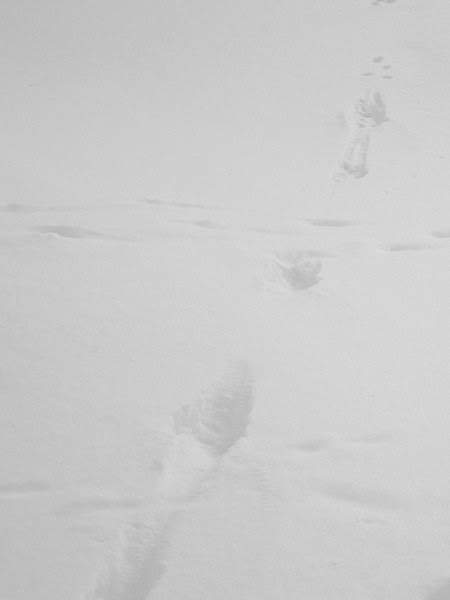


Minks can manage to get under the ice without otters around, but minks can't resist taking advantage of the holes the otters make. I followed the mink to a hole just behind the middle of the dam


While the mink used the hole, it didn't level about a shovel full of snow just outside the hole. An otter did that and left a couple prints. But I had hoped for more and at least a scat left in the snow. Standing on the dam, I looked down and saw that there was still a good flow of water coming out of the hole or holes the otters made.


Looking behind the dam I could see that the pond ice lowered uniformly except where the ice was braced by the dam, an old beaver lodge and tree stumps. All the old tracks behind the dam were probably left by deer.


Usually collapsing ice leaves a more roly-poly surface so I was a bit disappointed. A week ago I saw the tracks and scats otters made when they came out of a hole high on the bank about 30 yards west of the dam. I headed down there and saw that the pond in that direction was a bit roly-poly but more like a gentle wave, not the slash of ice planes I expected.


On the 11th the hole in the bank that the otters used was a couple feet above any water under the ice. Now it had to be even farther removed from the otters' source of food and the otters obviously stopped using that hole.


I was sure that the otters would suffer no inconvenience if I stuck a camera in the hole. I've taken these blind shots for years and the images I got this time were not very good. It looks like muskrats took advantage of rotting tree roots to make a den. I had often seen muskrats swim out of the bank around here, never any beavers. My guess is that the otters found the muskrats' old den and then dug a hole out to the open air. More snow and ice will have to melt before I can prove that.


In January all the stories the swamps tell unfold slowly. On January 24 I hiked out alone, again taking advantage of warmer temperatures and mindful of a chance of snow. We have not had much snow this month. Usually after a general snowfall of 6 inches we keep getting in an inch or two of lake effect snow every few days so that snow mounts. But this year we are losing snow very slowly from melting and sublimation. That's bad for otter tracking but it's good for seeing how the pond ice responds to a hole in the dam. When I got to the Lost Swamp Pond late in the afternoon I could better see the conflicted ice.


The otters apparently didn't squeeze out what holes cracked open when the ice sheet of the pond collapsed around those dead tree trunks. But the ice held up by shrub trunks next to an old beaver lodge, which would be an excellent place for the otters' to den, told a different story.


Getting closer, I got one of my best photos of ice showing bubbles likely left by otters swimming under ice now locked in a block of clear ice hanging high and dry over the current level of the pond ice that showed air bubbles made by the otters swimming under that ice.


The tracks in the snow around and on top of this ice platform were harder to decipher and I didn't see any otters scats in the area. Behind the other end of the dam there was another ice platform where some animals messed around.


Otters did much of the messing in that snow because I could see an otter slide in the ice between a gap in the ice right behind the dam and the ice platform.


In the upper left hand corner of the photo above there is what I hoped was a pile of otter scats, but it turned out to be coyote poop. The otters latrined on top of the dam,


leaving a muddy choppy trail in the snow all the way up to a generous pile of scats.


I didn't examine the scats too closely but it looked like the otters had been eating small fish, shiners, pumkinseeds, not the bullheads that used to make many an otter's meal in this pond. Between the scats and the pond ice, I saw a thin stick that a beaver had nibbled. Perhaps a beaver used the holes in the ice behind the dam too and came out in the cold fresh air for a snack.


All the activity I saw looked recent but since what could have been open water was all iced over, and since the bubbles under the ice were white and not pulsing with fresh air, and since there seemed to be no water flowing out of the holes through the dam, I couldn't positively say the otters were still there. When there were several active beaver families on this end of the island, otters moved from pond to pond, often traveling in late January. But this pond is about the only sure spot for a meal of fish within a mile so the otters might stay here all winter. It looked like they were having a good time so far. I'll check the pond again after we have some snow that will whiten the slate clean, so to speak. Heading home through the woods, I saw spots of blood in the snow.


I followed a trail of blood but no prints to the underside of hanging log. Such light footed work in the dawn hard snow, a weasel probably made the kill.

Friday, January 16, 2015

January 11, 2015

The foot of snow in the woods was deep enough for a porcupine to make a respectable trough.


That graceful trail came down from the rock dens half way up the steep slope on the east side of a wide ravine. At the other end of the woods there was another porcupine trail coming out of a den in low rocks completely covered by the snow.


Standing on the rock ledge looking down at the den has been my first sure stop in the winter woods for many years. Sometimes a porcupine was looking back at me. Not today. Then I faced the Big Pond. When it was indeed a pond, it was generally easy to cross in the winter because the west wind blew most of the snow off it. But now I faced a meadow.


The snow is always deeper in meadows and tracks are not easily seen. I miss the old days when I often saw tracks in the inch of snow spared by the winds that revealed the capering of coyotes. The Lost Swamp Pond was easier to cross. When I left the pond on the 2nd, I had the impression that the otters had breached the dam. So I expected the ice on the pond to have collapsed here and there as its water drained out. However, the snow was deep enough to smooth over any appearance of collapsing save where I saw a pool of slush beside the lodge which marked the new level of the water below the ice, perhaps a foot lower than it had been.


As I walked on I crossed the trail left by two deer as they investigated that low point, probably to get a drink of the water puddling there. Of course, I kept looking at the dam where I expected to see otter slides. I soon saw that there were none to be seen.


There was a depression in the snow behind the dam that went down to the new water level but it certainly didn't look like anything had used it to get under or out from under the ice. Because the beaver here doesn't forage for trees to cut, it hasn't had much interest in building up the dam and keeping the water level high. So the hole in the dam has been draining water out of a pond that did not have a high water level to begin with. For that reason, I expected the otters to live in the dam where muskrats over the years have fashioned dens. Several years ago otters breached the dam in December, went somewhere else and didn't return until late January, or so I recall without checking my journals. But otters keep sashaying around ponds and the river in December. When the cold hits in January, and we've had nights near 0F, otters get serious about settling down. I saw that water was still flowing out at the bottom of the dam.


Often the otters that made the hole keep tabs on it, but no signs of that. When this pond did have plenty of water and the otters breached the dam, they often found a den at the far west end of the pond; I suppose because the ice was thinner and easier to break through. So I walked down there. I saw deer tracks where I used to see otters coming out of holes in the ice. Not sure what the deer was after.


Then I saw a well used hole along the north shore of the pond up in the bank. I'd never seen otters here use a hole like that before but it immediately made sense to me.


Ideally otters like a den that offers them both access to the under ice world where they get their food and a place under the sun where they can poop and get a breath of fresh air for a few minutes. Since muskrats had often burrowed into the bank, I knew the otters could find a nice den there but with the pond so low, there was no easy access under the ice from there. However muskrats specialize in surviving in shallow water and they can mole their way under the ice leaving a nice little trench going from the bank out to a deeper part of the pond. Maybe the otters were taking advantage of that. No way I could tell until the next thaw, but I could document the otters' very brief dance outside their hole. There was a trough going a few feet along the bank to the west


And that's where an otter scatted.


Then there were two forays down the slight slope and out on the snow covered ice. The foray angling right ended at a small dead stump sticking out of the snow.


My hope is that a family of otters is using the den, which means a mother and pups born back in April 2014. It was easy to see the prints of an adult otter.


Only in the foray angling slightly left from the hole could I see evidence that there was a least one pup with the mother. One trail was too narrow for an adult otter to have made.


There was enough jumping about in the snow to suggest that there are two pups. At the usual otter hole in the ice, I used to thrust my camera down in it and get a look see that way. But this hole might lead directly to their den which should be kept a bit more private than their running room under the ice. I'll get a photo later when I think the otters moved to another den, as they surely will, to get closer to the pools of water left under the ice as water drains out of the dam. That's where the fish are. But that comes later in the winter. Fishing under the ice is a new experience for the pups which probably takes getting used to, but once they master it, they have to learn more about the roving ways of the otter. Traveling in the snow is an otter's forte. The hike out on snowshoes had not been easy so I backtracked to get home. Next time out we might use cross country skies and pressing down again on the same trail might make skiing easier. I don't mind going back the way I came because I usually see something I missed on the way out.


Today I saw a tree bent down for a porcupine's dining pleasure.

Wednesday, January 7, 2015

January 2, 2015

I went out the day after hunting season ended. Not worried about being shot by a Nimrod in a tree stand, I could walk with my eyes down looking for tracks in the snow. So I missed the barred owl in the tree in front of me. He flew off to my right but didn't mind my following him.


Obviously there is no better way to begin a journal entry. I saw an owl. How wise is that. But I saw the owl back on December 15, two weeks ago and about 20 months after my last journal entry. I didn't come out looking for owls. I was checking on a beaver trying to tie up loose ends, or, rather, to see them tied up for me. Most of the beaver ponds I used to watch have matured into beaver meadows, a nice way to put a sad fact: the beavers that built the beautiful ponds that entranced me since 1994 were gone. Back in the summer I saw that a beaver was still in the Lost Swamp Pond. I hadn't been out at pond since late September. So I came to see if it was still there.

After the owl flew off, I turned and walked down to the Lost Swamp Pond and I saw immediately that the beaver was almost surely still there. All the pond was iced over except for an open pool of water behind the beaver lodge.


There were also enough thin branches sticking up out of the ice on one side of the lodge to pass for an adequate winter cache for a beaver or two. But I didn't see anything cut along the shore of the pond. For years chronicling the winter lumbering of the beavers fueled my journals. This beaver did nothing to chronicle. For the last three winters it had survived in the pond without cutting a single tree. But I was glad it was there. It meant that I might come out to the pond during thaws on chance that I might see the beavers and thus prove that it is there. Then I thought I saw a beaver floating in the pool of water. I didn't have my binoculars so couldn't be sure. I took a photo.


Then as I walked over to the dam, the beaver floating in the pool of open water slapped its tail.

Periodically this beaver had worked on the dam, especially when it had a companion. Unfortunately, I didn't see any activity along the dam but I took a photo so I'd have a before photo if something happened after worth writing about.


The few inches of snow we had soon melted. No white Christmas but it did get cold a few days later. Checking frozen ponds when there is no snow cover is one of the pleasures of winter, especially early in the season when the ice is not scarred and made opaque by the incredible contortions water is put through during a long winter. Unfortunately the ice was not thick enough to walk on. I tried and saw water seep into the long crack made by my tentative steps. So I couldn't go out and see how many bubbles were under the ice near the lodge.


I did see bubbles under the ice as I walked along the north shore of the pond heading up to the dam.


Under the ice and bubbles I could see sticks stripped by a beaver, but, of course, the sticks could have been stripped long ago and the bubbles under the ice might have been made by muskrats. A few feet farther along the shore, I saw a new muskrat pyramid of grass, an airy place for it to catch a breath and warm up.


But that white blob of a bubble was one big bubble for a muskrat to make. Bubbles primarily come from air escaping from the fur of mammals swimming under water. That leaves a nice trail of small bubbles in the case of a muskrat, larger for a beaver. That big bubble however looked like the upshot of a huge exhale of air. Up at the dam there were more big bubbles under the ice


and there were craters, if you will, of holes in the ice that had frozen over.


This certainly looked like an otter had been swimming under the ice behind the dam and cracking up for a breath of air. But beavers do that too. I checked the latrine where otters usually scat when they visit this pond, and saw a bit of scat, but it did not look that fresh.


I had a good bit to think about as I walked home but I didn't start writing a journal. I was excited enough to tell Leslie and after a fresh snowfall on New Year's Day she woke me up on the 2nd with the cry of "let's go see the otters." I pooh-poohed such boasting and off we went.

After 20 years of checking on beavers ponds both my brain and the terrain are wired with a circular route that takes me to each of the dozen or so ponds I used to watch. So even though the Lost Swamp Pond is the only one that still has a resident beaver, we had the Big Pond to contend with first. Though no longer "Big", it did have a few pools of water, freshly frozen, and the inch or two of snow gave some relief to the brown of the all the vegetation in and around the pond. I saw some muskrat lodges that I hadn't noticed before.


These whirls of dead grass generally last one winter. When the Big Pond was big, I once walked on the ice and counted 13 large muskrat lodges. Muskrats generally live in burrows in the bank, or in beaver lodges that are protected with mud and sticks. But they also prepare places to get themselves out from under the ice as they browse for greens to eat. Coyotes and minks invariably dig into these grass lodges. Indeed a coyote had already dug into the biggest of the four we saw around the pond.


The coyote left its prints and pee in the snow and probably got nothing to eat because the muskrat could escape out in the pond and swim to another pile or into a burrow in the bank. There were bubbles under the ice around the pile the coyote had dug into.


I have great respect for coyotes but mammals who operate under the ice are a higher order of being, muskrats especially. Beavers and otters usually make sure they can operate in relatively deep water. Their skill at swimming is well known to all who watch nature shows on TV. Ponds can freeze solid so operating in water too deep to freeze is important but not to muskrats. When the ice freezes thick down to the pond mud, they make trails in the mud under the ice. Sounds easy until you try to visualize it, and then you get a headache. As we walked up the pond we crossed a snaking crust of ice where water rushing into the shallow pond after some rain had bubbled up through a crack in the ice and froze as the temperature plunged.


We were able to walk on the ice of the Lost Swamp Pond but we stayed away from the beaver lodge, it being too early for my annual plunge thru thin ice.


Of course we didn't walk directly up to the dam either for the same reason. We went up on a roll of granite, just a billion years old, and from there saw the ephemera we longed to see.


In the snow all animals make tracks, otters write journals so enigmatic that the only way I can decipher them is by writing my own journal.


The wide deep troughs in the photo above prove an adult otter couldn't resist bellying down in the snow. Back in 1997 I saw two adult otters play in the first snow of the year but they didn't mess around like what I was seeing in 2015. We strained to see sure proof that a mother and two or three pups had just been up on the ice. The mother otter hunkers down with her pups in beaver ponds for the long winter and now and then they come out from under the ice usually at dawn and.... you look at the mess they left and try to figure it out.


We didn't walk over the tracks and look for small prints even though snow or thaw would soon cover or clean up the mess of slides. It had been so long since we had seen something like this that we didn't want to mar it. Since otters live off the fish in the pond, they don't look for anything to eat on the ice and rocky shore. But they do have to leave their mark to warn other otters away. We saw a huge black scat, two small brown squirts and generous pee stains in the snow.


That doesn't necessarily add up to a mother and two pups. Otters often do a dance before they poop, rolling around in the snow, then sniffing the spot first, then turning around and letting fly. In the photo above a big print is easy to see. I think I see a small one too. But Leslie and I were both struck by the shapes in the snow with lines left by an otter's fur.


An adult otter would flatten the snow. A lighter pup might caress it in just that way.

If adults made all the slithering slides, they might leave this pond and go anywhere, back to the St. Lawrence River, for example, where we have seen scats along the shore during the fall. But a mother and her pups will probably stay. We could hear water rushing through the dam maybe just from the freezing and thawing, but probably because mother otter is letting water out of the pond to make it easier for her and her pups to find fish. Time will tell. And with an otter making holes in the ice and draining the water out of the pond, we might soon see that beaver come out at the dam, not to repair the dam but to get some fresh air.

I was already writing future journal entries in my brain. I've watched this unfold many times over the years. I'm back being schooled by otters. As usual, with the senses livened up other things begin to fall in place. Leslie dared me to go home by a very old route up the grandest granite slope. At the base of it I stumbled over fresh porcupine poop and got a glimpse of its steamy den.


Up just beyond the crest of the granite, a flock a cedar waxwings were nipping buck thorn berries or sprucing their feathers in the cold wind.